Debate Breakdown: Perspectives on Term Limits for the U.S. Supreme Court
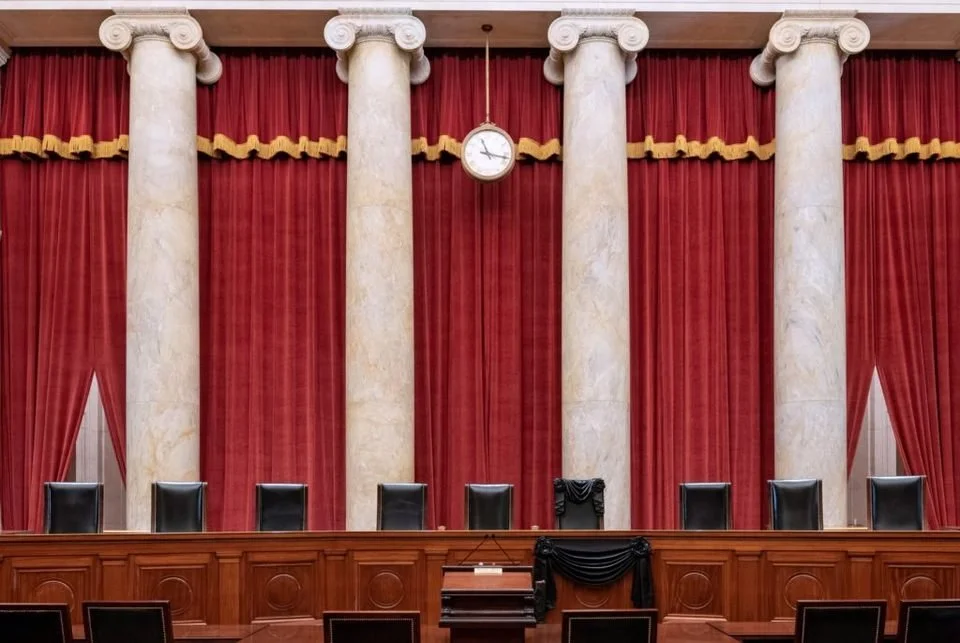
MMiller. “Is Eight Enough? How the Supreme Court Functions with Only Eight Justices.” Pacific Legal Foundation, 30 Sept. 2020, pacificlegal.org/how-the-supreme-court-functions-with-eight-justices/. Accessed 23 Oct. 2025.
Disclaimer: This research article is solely intended to be an opinion piece published by students that is corroborated by facts and credible sources. Under no circumstances should any article published by the UNLV Undergraduate Law Review be considered as actual legal advice or legal counsel.
Introductory Reflection
The Supreme Court has influenced the lives of every American, from the passage of the Constitution, to its role in modernity. As history has noted, the Constitution instituted the Court, in Article III, explaining that, “The judicial Power of the United States, shall be vested in one supreme Court, and in such inferior Courts as the Congress may from time to time ordain and establish. The Judges, both of the supreme and inferior Courts, shall hold their Offices during good Behaviour, and shall, at stated Times, receive for their Services, a Compensation, which shall not be diminished during their Continuance in Office.” Article III of the United States Constitution established the judicial branch of government and the Supreme Court system as known today. The length of each justice’s service is defined only by their maintenance of “good [b]ehavior.” [5] Article III is much more concise when compared to the other sections of the Constitution, such as those establishing the legislative or executive branches, leaving it for government officials to build off of the framework provided. [5] Throughout history and even today, there remains much discussion on imposing term limits on justices of the U.S. Supreme Court. Is a reactionary court more prepared to deal with the challenges of our fast-paced current world, or should we maintain doctrinal stability to ease out some of the polarization of the modern age? Issues are presented on both sides of the debate, and each can be observed to better understand how judicial reform could impact the court, with potential consequences that are both beneficial and detrimental. Currently, there are numerous convincing arguments for change; however, as long as there remain clear, real, and logical arguments for the current system, change may be ill-advised. Additionally, any reform is unlikely due to the high level of disagreement and political polarization prevalent in the modern age.
The History of Supreme Court Reform
The concept of judicial reform in America is nothing new. Throughout our nation’s history, numerous attempts have been made to change the structure and system of the Court, some of which have been successful, while others have not. An author for the Congressional Research Service published a piece about the history of court reform, describing how, “in the early 1800s, Congress enacted far-reaching alterations to the federal judiciary—including a change to the Court's size—only to repeal the changes when control of Congress shifted.” [10] This is one of numerous examples that show how efforts have been made to change the court. [10] Yet, none have succeeded, ultimately leading to a system where justices serve for terms usually longer than their elected counterparts in different branches.
The congressional researcher explained a connection and motive for the creation of term limits. They noted how one of the grievances that led to independence by the colonists was how King Charles III had effectively instituted a system of judicial control through monarchy, and so, “when establishing the federal judiciary, the Constitution's Framers decided to insulate judicial tenure from political control […] the Federalist Papers suggest that federal judges will be ‘secured in their places for life’ so long as ‘they behave properly.” [10] This system has been mainly preserved and unchanged, though that is not to say that efforts still continue to alter it. The most recent decisions to seek change in the Court were made in early 2021 by President Biden, who, through Executive Order 14023, launched a commission to explore possible changes to the Court. With the end of President Biden’s term not bringing any action on Court reform and the administration change to President Trump, efforts from before have not been continued, so it would require a renewed effort to create any fresh initiatives.
Arguments for Term Limits
One of the core viewpoints on the topic of term limits for Supreme Court justices revolves around creating some form of limitation. This perspective is currently dominant in the eyes of the electorate. An Annenberg survey published in 2024 described how 68% of individuals surveyed prefer a term or tenure limit be implemented. [2] There is much discourse on how long such a term should be. The Brennan Center for Justice provides an explanation of a prominent proposition suggesting a term of 18 years, creating a two-year system where every president would appoint two justices during their term. [1] Many Supreme Court Justices themselves have expressed openness to such limits. Justice Stephen Breyer notably stated in 2016, “If there were a long term – 18, 20 years, something like that – I’d say that was fine. In fact, it’d make my life a lot simpler, to tell you the truth.” [3]
The core argument behind adding term limits is that such a change would create a more agile and relevant court, one that is responsive to the rapidly evolving modern world that is dominated by social media and the mercurial news cycle. A 2025 Pew Research study found that 50% of participants held unfavorable views on the Supreme Court. [6] As one commentator noted: “The average justice’s term is now longer than it has been at any other point in U.S. history […] Happenstance can result in presidents getting a greater or lesser number of appointments, potentially resulting in a court that is widely out of step with society as a whole.” [4] By bringing in new justices on a consistent, rotating basis, the Court would more accurately reflect the political viewpoints of the populace, making it somewhat closer to a democratically responsive body.
One of the largest roadblocks to implementing any such term limit on the Court is the fact that lifetime tenure is guaranteed in the Constitution. Some argue that a simple piece of legislation could allow for justices to continue service as what are referred to as senior judges, meaning that they can remain justices and simply complete work in a different capacity outside of the Supreme Court, which some would argue meets the requirement for lifetime appointment. [7] This proposition does have some merit in the current system for justices. By applying this rule and implementing the proposed change, the viewpoint overall advocates that the Court would be more responsive, relevant, and democratic.
Arguments Against Term Limits
Though many advocate for the imposition of term limits, numerous scholars and legal professionals feel it would be detrimental to pursue such changes. The term politics contains a negative connotation in relation to the judicial system as many hope for an apolitical judiciary. Politics are present in any space where decision-making occurs, and in America, the political landscape is constantly evolving as elections and legislative measures take place. The process of appointing a Supreme Court justice is already political, as the guiding issue is the ideological viewpoint of the President and the majority party in the Senate. Some raise questions about whether such an active cycle of two years, as suggested, would create an even more political Court. A judicial publication from author Arthur Hellman describes how, “the scheme would lead to a permanent war over Supreme Court appointments, akin to the ‘permanent campaign’ and indeed perhaps part of it.” [8] Additionally, Hellman explains that the process of selecting cases to argue before the Court could become politicized, noting how, “each Justice will know exactly how long his ideological allies (and adversaries) will be staying on the Court” therefore creating the opportunity for a Chief Justice to hold the consideration of a case until justices of their viewpoint hold the majority again. [8] This reasoning highlights a key concern: term limits could create new opportunities for political gamesmanship.
It is no secret that the Court often hears cases involving polarizing and often politically charged issues from across the United States, leading it to make judgments that could significantly alter the country’s course as a whole. Another less prominent concern is how Supreme Court justices are expected to find another occupation after their term if the limit is applied. American Enterprise Institute senior fellow Adam White articulated this concern, noting that justices do not need to worry about how their decisions might affect future employment prospects because of lifetime tenure (assuming they do not retire or have other opportunities to pursue afterward) . White explained how, “We don't want the justices looking over their shoulder at what their next job is going to be.” In essence, one ought to avoid creating a Court that succumbs to severe bribery or a necessity to please those in power. Timmer conducted extensive interviews with state supreme court justices to investigate whether elections or the idea of job security affects justices in current state supreme courts. The researcher reported a reflection from a justice explaining how, “no one is going to say, ‘if I rule one way I won’t be reelected.’ But in private conversations, judges will express concern about being reelected. [...] anxiety sets in and you start to worry about a number of things including retention.” [13] This is a tough reality that could ensue, and if justices serve for a limited or short period, they may need to worry about how their decisions may be interpreted by the elected officials in power who serve as their electorate at that time.
Finally, there is the issue of doctrinal stability, with scholars Suzanna Sherry and Christopher Sundby explaining how, “longevity and stability mean that doctrine changes slowly and incrementally. A constantly changing court, on the other hand, might make sudden and radical changes in doctrine.” [12] This brings in the crucial question of change versus stability. Although adaptability is good, one could unintentionally create a Court that overrules itself with the addition of every new appointment cycle. All in all, the arguments revolving around how limits could create a politicized or corrupt court make for a case against setting term limits of any kind.
Concluding Reflection
Today, term limits on the court remain a contentious point of discussion: should they be applied at all, and if so, what should their duration be? An important piece of legislation introduced only a few months ago is the Supreme Court Tenure Establishment and Retirement Modernization Act by Congressman Hank Johnson (GA-04). [9] Reintroduced this year, the legislation proposes an 18-year term limit for justices of the nation’s highest judicial body and would establish a system of staggered appointments so that a new justice is effectively added every two years. If enacted, this legislation could create positive changes, but it might also trigger negative impacts that, according to the opposition, could instill a more politicized Court structure. Numerous pieces of similar legislation have been introduced in the past with no avail, and it is therefore unlikely that any legislation creating a form of limit will be enacted in the near future. Given the polarized nature of the modern political and governance system, as well as the existing high level of quality arguments on both sides and current disagreement on this specific issue, there appears to be a large gap between viewpoints and legal possibilities. [11] The question then remains: which standpoint will persuade and persevere?
Sources
Alicia Bannon, and Michael Milov-Cordoba. “Supreme Court Term Limits.” The Brennan Center for Justice, June 20, 2023. https://www.brennancenter.org/our-work/policy-solutions/supreme-court-term-limits.
Annenberg Public Policy Center. “A Majority of Americans Can’t Recall Most First Amendment Rights.” The Annenberg Public Policy Center University of Pennsylvania, September 12, 2024. https://www.annenbergpublicpolicycenter.org/most-americans-cant-recall-most-first-amendment-rights/.
Association of American Law Schools. “2016 AALS Annual Meeting – a Conversation with the Honorable Stephen Breyer, U.S. Supreme Court.” YouTube, March 28, 2016. https://www.youtube.com/watch?v=SjqKy8WOkP0.
Buchanan, Maggie Jo. “The Need for Supreme Court Term Limits.” Center for American Progress, August 3, 2020. https://www.americanprogress.org/article/need-supreme-court-term-limits/.
Constitution Annotated. “U.S. Constitution - Article III.” Library of Congress, 1787. https://constitution.congress.gov/constitution/article-3/.
Copeland, Joseph. “Favorable Views of Supreme Court Remain near Historic Low.” Pew Research Center, September 3, 2025. https://www.pewresearch.org/short-reads/2025/09/03/favorable-views-of-supreme-court-remain-near-historic-low/.
Gertner, Nancy. “The Constitution Allows for Term-Limited Supreme Court Justices.” Brennan Center for Justice, November 20, 2024. https://www.brennancenter.org/our-work/analysis-opinion/constitution-allows-term-limited-supreme-court-justices.
Hellman, Arthur. “Reining in the Supreme Court: Are Term Limits the Answer?” Reforming the Court: Term Limits for Supreme Court Justices, 2006, 291. https://scholarship.law.pitt.edu/fac_book-chapters/36/.
Johnson, Hank. Supreme Court Tenure Establishment and Retirement Modernization Act of 2025 (2025). https://hankjohnson.house.gov/sites/evo-subsites/hankjohnson.house.gov/files/evo-media-document/term_act_2025.pdf.
Lampe, Joanna R. “Congressional Control over the Supreme Court.” Library of Congress, December 6, 2023. https://www.congress.gov/crs-product/R47382.
Martinez, A. “The Arguments against Setting Term Limits for Supreme Court Justices.” NPR, August 5, 2024. https://www.npr.org/2024/08/05/nx-s1-5060213/the-arguments-against-setting-term-limits-for-supreme-court-justices.
Sherry, Suzanna, and Christopher Sundby. “The Risks of Supreme Court Term Limits.” SCOTUSblog, 2019, https://www.scotusblog.com/2019/04/academic–highlight-the-risks-of-supreme-court-term-limits/. https://scholarship.law.vanderbilt.edu/faculty-publications/1091/.
Timmer, Ann A. Scott. “Boxed In: Does the Prospect of Re-Selection Influence Judicial Decision Making?” Judicature. Bolch Judicial Institute, 2019. https://judicature.duke.edu/articles/boxed-in-does-the-prospect-of-re-selection-influence-judicial-decision-making/.