The Silent Concert: The Isabella Stewart Gardner Museum Heist, 35 Years Later
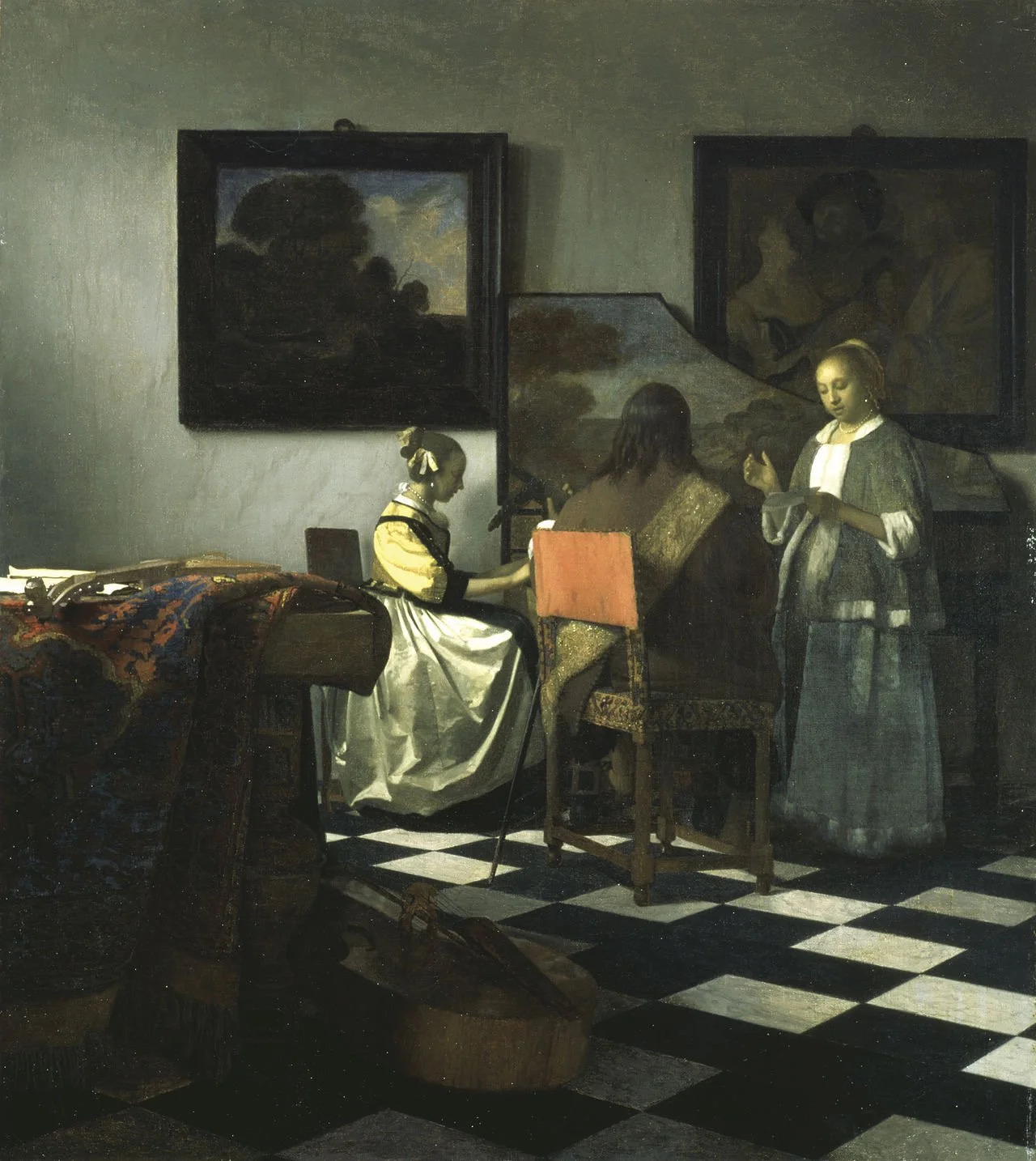
The Concert by Johannes Vermeer circa 1664, image courtesy of Wikipedia, via https://en.wikipedia.org/wiki/The_Concert_(Vermeer)#.
Disclaimer: This research article is solely intended to be an opinion piece published by students that is corroborated by facts and credible sources. Under no circumstances should any article published by the UNLV Undergraduate Law Review be considered as actual legal advice or legal counsel.
A Missing Melody: The Masterpiece in Question
The walls within the estate of Théophile Thoré existed as the second-to-last publicly known location of a particular set of two paintings inside a painting created by a mysterious man named Johannes Vermeer. [11] An eccentric heiress named Isabella Stewart Gardner acquired this unique work at a 19th-century auction hosted by the estate. [11] She took the piece to her eponymous museum in Boston, Massachusetts, where it remained unmanipulated until a fateful heist on March 18th, 1990, which removed the painting, titled The Concert, from the public eye until the present day. [10] The Federal Bureau of Investigation's (FBI) Art Crime Team primarily investigates the case and advertises a $10 million reward for any information that leads to the acquisition of The Concert and twelve other paintings targeted in the St. Patrick’s Day smuggling. [18] The Art Crime Team’s founder, Robert K. Wittmann, reiterated a legal caveat to this case in 2024. [2] Wittmann proposed that even though experts estimate this painting as the most expensive stolen item in the world and a priceless piece of cultural property, the person who stole it may not receive any consequences. [2]
The Case Crescendos: The Stakes are High While Justice is Low
The creator of The Concert, Johannes Vermeer, remains anonymous to this day. [16] Any information about him is speculative, meaning that Vermeer could very well be a pseudonym for a once-in-a-lifetime talent, a group of once-in-a-lifetime talents, or a name for a con man whose identity has escaped their legacy. [16] Only 33 other paintings in the world are attributed to Vermeer, renowned for his precise usage of linear perspective. [6] For reference, another Dutch artist, Frans Hals, has about 200 paintings attributed to him. [3] Meanwhile, other famous artists like Picasso have over 20,000 works attributed to their name. [22] Vermeer, despite his small body of work, exhibits such mathematical accuracy in the proportions of his paintings that his use of perspective not only exists as one of the ways experts have identified his paintings, but other artists have accused him of using technology, such as the camera obscura, in his work. [9] Regardless of these accusations, professionals remain unable to prove Vermeer’s use of visual aids to this day, making his work more valuable because of its unique hand-drawn precision, comparable to that of Renaissance artists who not only emerged centuries later but were known for having technological advances to perfect the perspective in their paintings. [13] Examples would include Leonardo Da Vinci, who historians say had access to an entire manual dedicated to the mastery of linear perspective, written nearly 200 years after Vermeer’s death. [13] Furthermore, other works from Vermeer’s time prevail as notorious, some would even say visually unappealing, due to a lack of linear perspective, mirroring prehistoric art as opposed to Renaissance art like his catalog. [19] Vermeer’s futuristic talent and lack of works attributed to him contribute to the fact that The Concert is worth about $250 million today, making it the most valuable stolen painting in the world, poached from the public eye. [12]
Speculative Staccato: How Would the Thieves be Punished?
As mentioned before, Robert K. Wittman provided information on how the thieves of The Concert would be punished, if at all. [2] Since their identities remain anonymous, three suspects are attached to the case even though multiple reports say two people stole the art. [4] As of 2021, all three of these suspects are dead, possibly taking the whereabouts of the artwork they stole to their graves. [4] The deaths of these suspects could lead to the arrest of the real suspects, as it could influence certain people, possibly silenced by the now deceased suspects, to divulge information. This is especially true in consideration of the fact that since their identities remain anonymous, the real culprits could be alive today. Wittman, however, asserts that the FBI would most likely not punish the thieves because it has been “thirty years” and they are most likely deceased. [2] Additionally, the Statute of Limitations for thefts over $250 in Massachusetts (where the theft occurred) is six years, meaning they expired in 1996. [14] Outside of this, Wittman claims that the paintings are most likely in France and that if this is the case, then, “under French Law, these paintings aren’t stolen anymore.” [2] Furthermore, since these paintings were stolen in America, if they are in any other country but America, then whoever owns these paintings now is likely legally entitled to them, with little obligation to return them to the museum from which they came. [2] Additionally, this raises questions about whether the museum owns the painting, and for what, or whom, the elusive artist, Johannes Vermeer, intended the painting.
Previous Pizzicatos: Were Past Culprits Perpetrated?
Something similar to the Gardner museum heist, albeit less expensive, happened in Stockholm, Sweden, in December 2000. [5] In this incident, a group of people stole a self-portrait by Rembrandt van Rijn. Even though the Old Master created several self-portraits, around 40 of which survive today, his work remains valuable. [15] This results from the fact that, like Vermeer, Rembrandt has few paintings attributed to him, a mysterious identity, and exhibits excellent technique in his artwork. [15] Furthermore, 3 of Rembrandt’s works were stolen in the Gardner Museum heist, just a decade before the portrait in question. [10] The thieves who stole the portrait seem to have maintained anonymity, enhanced by the fact that some sources say up to 13 people conspired to take the painting. [5] In this instance, the thieves attempted to sell the portrait, but made the mistake of selling it to none other than Robert K. Wittman himself, who, backed by Dutch Police, acquired the portrait and sent 8 of them to prison. [2] While one could liken this series of events to the Gardner Museum heist, it is difficult because the schematics of this case, beyond the aforementioned circumstances, do not relate to those of the Gardner Museum heist. For example, 13 people were linked to stealing Rembrandt’s self-portrait by 2001, about a year after the theft. [5] Meanwhile, less than 10 people are linked to the Gardner Museum theft over 30 years later. [4] This makes it more difficult for authorities to question people and establish the location of the artwork, especially as time passes. Additionally, only one painting was taken in the 2000 crime, while 13 were stolen in the Gardner heist. This makes it more difficult to locate each painting if they were separated after the crime. Because the Gardner Museum heist lacks a significant amount of information and a large amount of stolen property, this separates it and its outcome from other cases that surround art theft.
A Largo in Law: Can International Law Help?
In 1970, UNESCO hosted a cultural convention in which they prohibited the “import, export or transfer of ownership of cultural property effected contrary to the provisions adopted under [the] Convention by the States Parties.” [20] Over 100 countries accepted or ratified this convention. The United States notably accepted the treaty, and France ratified it. [20] For context, according to the United Nations Treaty Collection Glossary, acceptance has “the same legal effect as ratification and consequently [expresses] the consent of a state to be bound by a treaty… acceptance and approval have been used instead of ratification when, at a national level, constitutional law does not require the treaty to be ratified by the head of state.” [21] Since both countries consent to this treaty, this appears to contradict Whittman’s proposal that the perpetrators of the Isabella Stewart Gardner Museum heist would be punished for their actions, especially in consideration of the fact that France’s signage of the 1970 UNESCO convention overrides their current laws in place, such as article 2279 of their civil code which gives people a time limit (which expired in 1993) to retrieve their stolen property. [17] Upon closer inspection, the most severe form of punishment proposed in the cultural convention in response to the theft of cultural property is “administrative sanction.” [20] The General Multilingual Environmental Thesaurus defines this as “any formal official imposition of penalty or fine,” which could include “destruction, taking, seizure, or withholding of property; assessment of damages, reimbursement, restitution, compensation, costs, charges or fees; requirement, revocation or suspension of license; and taking other compulsory or restrictive action by organization, agency or its representative.” [1] This multifaceted risk of punishment presented by UNESCO in response to the theft of the artwork does not appear to be intimidating or consistent, and a majority of the convention focuses on the establishment of methods to inform the public on stolen pieces of cultural property, which includes artwork. [20] The anonymity and old age often contributed to the culprits of the case in question likely absolves any parties from punishment, especially in consideration of the fact that the convention does not address action against accomplices to the theft of cultural property. [20] So, in tandem with Wittman’s claims, regardless of where the pieces are today, the most laborious action taken upon their recovery would be their placement back in the Gardner Museum, not the punishment of the thieves.
Tentative Tremolo: Will We See the Paintings Again?
Based on this information, as painful as the reality seems, it is very unlikely that these paintings will see the light of day again. In between the lack of information and legal incentives that would disclose the location of these works, there does not appear to be any reason for their owners, if any, to return them. Though the painting’s reemergence seems unlikely, it is far from impossible that the world would be able to experience these works from a less technical perspective. Consistent media coverage revolving around the theft on the part of the museum brings more public attention and pressure to the case, at the very least, bringing appreciation to the works of art despite their physical absence. [4] The $10 million reward the museum is offering for the recovery of the pieces may elude the interests of anyone involved with the crime as it only covers a fraction of the stolen art’s collective worth, estimated to be worth hundreds of millions of dollars today if recovered. [12] The Gardner Museum’s endowment was estimated to be over $90 million as of 2020, meaning that an increase in the reward money remains possible. [7] The increase in digital technology and different ways to experience artwork also allows these pieces to survive and for people to see them in different ways. From their high-resolution variants on Wikipedia to reimaginations powered by augmented reality on Google Arts and Culture, there are digital efforts committed to educating future audiences on the work without physical companionship. [8] While the physical works of art remain elusive, their frames remain on the walls of the Gardner Museum, devoid of canvases yet filled with optimism. [10]
Sources
"Administrative Sanction." The General Multilingual Environmental Thesaurus. Last modified December 6, 2021. Accessed July 20, 2025. https://www.eionet.europa.eu/gemet/en/concept/112.
"Art Heists: Inside the FBI's Pursuit of Stolen Masterpieces." Video. YouTube. Posted by The Mob Museum, September 6, 2023. Accessed June 18, 2025. https://www.youtube.com/watch?v=4reOX4t58j4.
Art Institute Chicago. "Frans Hals." Art Institute Chicago. Accessed June 16, 2025. https://www.artic.edu/artists/34811/frans-hals.
Cascone, Sarah. "Robert 'Bobby' Gentile, Long Fingered by the FBI as a Suspect in the 1990 Isabella Stewart Gardner Museum Heist, Dies at 85." artnet. Last modified September 23, 2021. Accessed June 18, 2025. https://news.artnet.com/art-world-archives/gardner-heist-suspect-robert-gentile-2012506.
CODART. "Rembrandt Recovered! Self-portrait Stolen from National Museum in Stockholm Recovered in Copenhagen." CODART. Last modified September 16, 2005. Accessed July 6, 2025. https://www.codart.nl/museums/rembrandt-recovered-self-portrait-stolen-from-nationalmuseum-in-stockholm-recovered-in-copenhagen/.
Eaker, Adam. "A New Look at Vermeer." The Met. Metropolitan Museum of Art. Last modified June 5, 2018. Accessed June 16, 2025. https://www.metmuseum.org/perspectives/vermeer-new-look.
"Gardner Museum Has Raised $100M in New Capital Campaign." MassNonprofit News. Last modified April 19, 2020. Accessed June 18, 2025. https://www.massnonprofit.org/features/innovation_and_strategies/gardner-museum-has-raised-100m-in-new-capital-campaign/article_03f4aad3-19d5-5f93-b8aa-101dfcc89357.html.
Google Arts and Culture. "Thirteen Works: Explore the Gardner's Stolen Art." Google. Accessed June 18, 2025. https://artsandculture.google.com/story/QAUxZKoNat4oLA?hl=en.
Gorman, Michael John. "Art, Optics." ISAST 36, no. 4: 295-301. Accessed June 22, 2025. https://pages.cs.wisc.edu/~dyer/ah336/papers/gorman-hockney-thesis.pdf.
Isabella Stewart Gardner Museum. "Learn about the Theft." The Isabella Stewart Gardner Museum. Accessed June 16, 2025. https://www.gardnermuseum.org/about/theft.
The Isabella Stewart Gardner Musuem. "The Concert." Isabella Stewart Gardner Musuem. Accessed June 16, 2025. https://www.gardnermuseum.org/experience/collection/10966.
Jones, Christopher P. "This Vermeer Painting Breaks the Record for the Most Valuable Object Ever Stolen." Medium. Last modified March 21, 2023. Accessed June 16, 2025. https://christopherpjones.medium.com/this-vermeer-painting-breaks-the-record-for-the-most-valuable-object-ever-stolen-373adaad43bc.
Museum of Science, Boston. "Activity: Linear Perspective." Musuem of Science. Accessed June 16, 2025. https://www.mos.org/leonardo/activities/perspective.html.
Nathan, Geoffery G. "Grand Larceny Vs. Grand Theft Sentencing." Geoffery G. Nathan Law Offices. Accessed June 18, 2025. https://www.geoffreygnathanlaw.com/topics/grand-larceny-vs-grand-theft-sentencing/.
"REMBRANDT: A Genius and His Impact." NGA. Accessed July 6, 2025. https://nga.gov.au/exhibitions/rembrandt/.
Richard, Diane. "Who Is Vermeer?" National Gallery of Art. Last modified October 7, 2022. Accessed June 16, 2025. https://www.nga.gov/stories/articles/who-vermeer.
Rouhette, Georges, and Anne Rouhette-Berton. "Civil Code." University of Lisboa. Accessed July 27, 2025. https://www.fd.ulisboa.pt/wp-content/uploads/2014/12/Codigo-Civil-Frances-French-Civil-Code-english-version.pdf.
"Stolen Museum Artwork." Federal Bureau of Investigation. Accessed June 16, 2025. https://www.fbi.gov/wanted/seeking-info/stolen-museum-artwork.
Tyler, Christopher, and Michael Kubovy. "Principles of Perspective." WebExhibits Science and Art of Perspective. Accessed July 13, 2025. https://www.webexhibits.org/sciartperspective/tylerperspective.html.
United Nations. "Convention on the Means of Prohibiting and Preventing the Illicit Import, Export and Transfer of Ownership of Cultural Property." UNESCO. Last modified April 24, 1972. Accessed July 20, 2025. https://www.unesco.org/en/legal-affairs/convention-means-prohibiting-and-preventing-illicit-import-export-and-transfer-ownership-cultural?hub=416#item-2.
"United Nations Treaty Collection Glossary." United Nations Treaty Collection. Accessed July 20, 2025. https://treaties.un.org/pages/overview.aspx?path=overview/glossary/page1_en.xml#:~:text=The%20instruments%20of%20%22acceptance%22%20or,by%20the%20head%20of%20state.
Voorhies, James. "Timeline of Art History." The Met. Metropolitan Musuem of Art. Last modified October 1, 2004. Accessed June 16, 2025. https://www.metmuseum.org/essays/pablo-picasso-1881-1973.